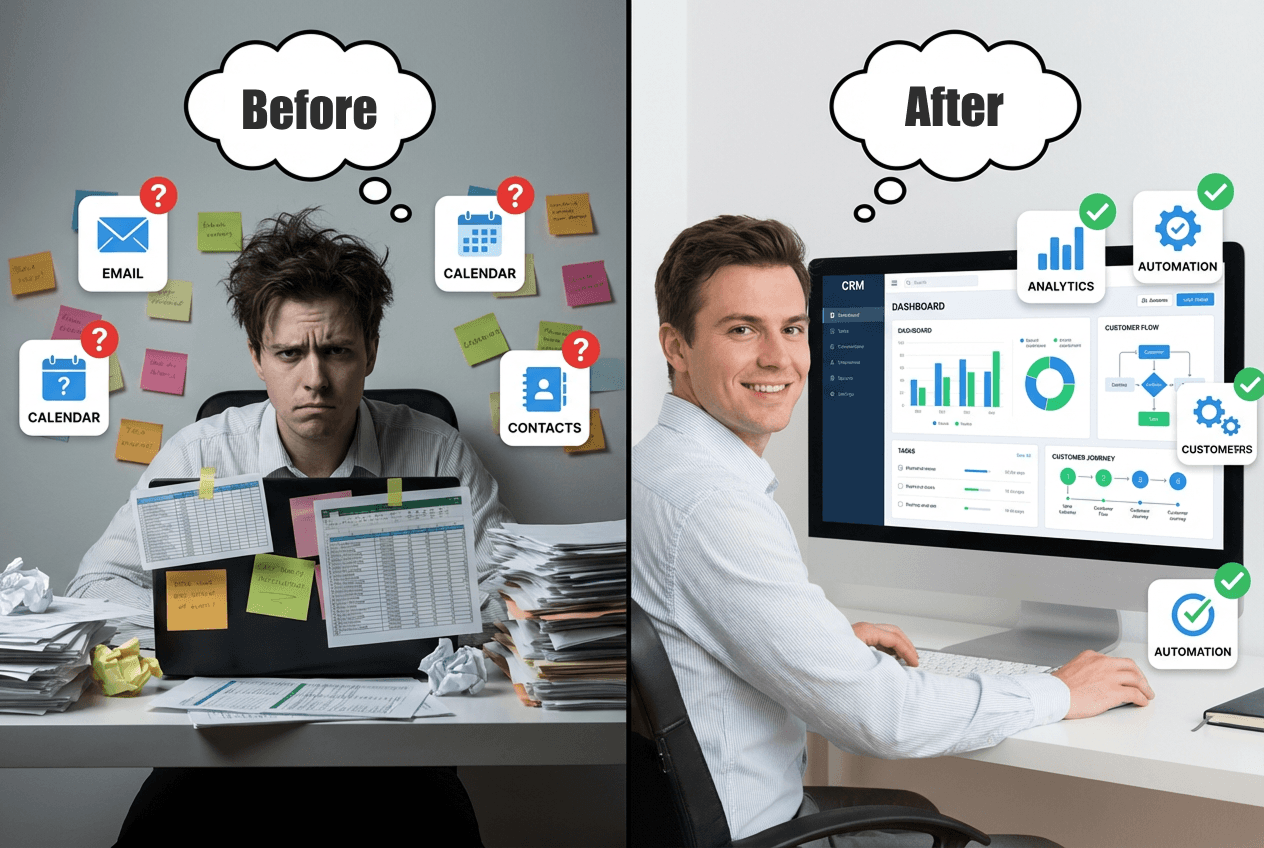
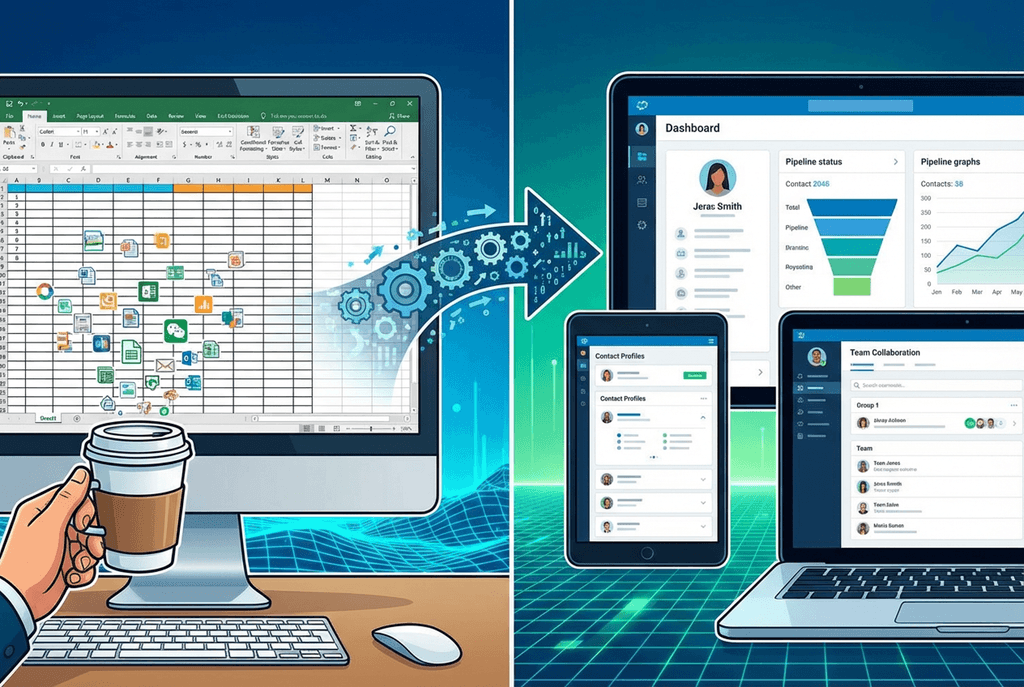
For many growing businesses, spreadsheets are the Swiss Army knife of operations. They're familiar, flexible, and free. But there comes a point where what once felt like efficient organisation starts feeling more like controlled chaos.
This isn't about spreadsheets being inherently bad. They're brilliant tools that have their place. The question is whether they're still the right tool for where your business is now.
The Spreadsheet Comfort Zone
Most businesses start with spreadsheets because they work. You can track customers, log sales conversations, manage follow-ups, and build reports. For a solo operator or small team where everyone knows what's happening, this system holds together reasonably well.
The problems emerge gradually. A second version of the customer list appears. Someone forgets to update their copy. A critical follow-up falls through the cracks because it was buried in row 247. Your newest team member spends their first week just trying to understand which spreadsheet contains what information.
It’s easy to see why it’s estimated that businesses lose an average of 5-10 hours per week per employee managing data across disconnected spreadsheets. For a team of five, that's one full working week every month spent on administrative overhead rather than revenue-generating activities.
Warning Signs You've Outgrown Spreadsheets
Several patterns indicate your spreadsheet system is reaching its limits.
Multiple versions of truth. When team members maintain separate spreadsheets because they don't trust the "master" version, or when preparing for a meeting requires reconciling three different files, you've lost data integrity. A Customer Relationship Management system maintains a single source of truth that everyone accesses simultaneously while allowing them to customise their view to suit their working style.
Invisible follow-ups. If someone asks "who's following up with that prospect?" and the answer requires checking individual spreadsheets or asking around, leads are falling through gaps. Research from InsideSales.com found that responding in under 5 minutes has an 8x higher conversion rate than responses between 6-30 minutes. When your follow-up system relies on individual memory and manual spreadsheet checks, you're losing deals to competitors with better systems.
Time wasted on data compilation. Sales meetings shouldn't start with 30 minutes of "let me pull those numbers." If creating a pipeline report requires exporting multiple spreadsheets, copying data between files, and manually calculating figures, you're spending valuable time on work that should happen automatically.
Inability to scale. When hiring a new salesperson means spending days explaining your spreadsheet system, or when they can't be productive for their first month because they're still learning where everything lives, your operations aren't scalable. According to the Australian Bureau of Statistics, businesses with 20-199 employees that successfully implement digital systems report productivity improvements of 15-25%.
No visibility into your pipeline. Strong businesses forecast accurately. If you can't immediately answer questions like "what's our total pipeline value?", "what's our average deal size?", or "which lead sources convert best?", you're making decisions based on instinct rather than data.
What You Gain by Making the Switch
Moving to a CRM isn't about replacing one tool with another. It's about fundamentally changing how information flows through your business.
Automated capture and routing. Leads from your website, LinkedIn, email inquiries, and other channels flow automatically into a central system. No more manual data entry. No more leads sitting in someone's inbox waiting to be added to a spreadsheet. Systems like Salesforce, HubSpot, or Microsoft Dynamics can connect with virtually any lead source and route prospects to the right team member based on criteria you define.
Clear accountability and follow-up. Everyone knows who owns each opportunity and when the next action is due. The system sends reminders automatically. Managers can see pipeline health without asking for updates. This visibility alone typically improves follow-up rates by 30-40%.
Real reporting without manual work. Dashboards update in real-time showing your pipeline value, conversion rates, deal stages, and team performance. Monthly sales meetings start with accurate data already prepared, not with frantic spreadsheet reconciliation.
Historical context for every interaction. When someone contacts your business, whoever picks up the phone sees the complete history: previous conversations, quotes sent, products they've inquired about, and support tickets. This continuity improves customer experience and increases conversion rates because your team isn't starting from scratch with every interaction.
Onboarding efficiency. New team members access a system with defined processes, clear data structures, and built-in workflows. What took weeks to learn in spreadsheets takes days in a properly configured CRM.
Common Concerns About Making the Change
"We'll lose all our spreadsheet data." Data migration is a standard part of CRM implementation. Your existing customer information, deal history, and contact details transfer into the new system. This migration also provides an opportunity to clean up duplicate records and fix data quality issues that have accumulated over time.
"Our team won't use it." Adoption challenges are real, which is why implementation methodology matters more than the technology itself. When teams resist new systems, it's usually because the system wasn't designed around how they actually work, or because they received inadequate training. Successful implementations involve the team in the design process and provide hands-on training for specific roles.
"It's too expensive for our business." CRM platforms now exist at every price point. HubSpot offers a free tier with core functionality. Zoho CRM starts at $20 per user per month. Salesforce Essentials targets small businesses at $25 per user per month. The question isn't whether you can afford a CRM—it's whether you can afford to keep losing time and deals to an outdated system.
The ROI typically appears within 6-12 months through time savings, improved conversion rates, and better customer retention.
"We're not ready yet." There's rarely a perfect moment. Waiting until the pain becomes unbearable means you've already lost significant revenue and wasted months of your team's time. The businesses that transition most successfully are those that recognise the warning signs early and make the change before it becomes an emergency.
Making the Transition Successfully
The difference between successful and failed CRM implementations usually comes down to approach rather than technology.
Start with clear objectives. What specific problems are you solving? Better follow-up? Improved forecasting? Faster onboarding? Customer retention? Clear goals drive better system design and give you metrics to measure success.
Choose the right platform for your context. The best CRM isn't necessarily the most feature-rich or the cheapest. It's the one that fits your business model, integrates with tools you already use, and matches your team's technical comfort level. A platform that works brilliantly for enterprise sales might be completely wrong for a retail business.
Clean your data before migration. Moving messy spreadsheet data into a CRM just gives you a messy CRM. Take time to deduplicate contacts, standardise formats, and remove outdated information. This cleanup work pays dividends because you're starting with a solid foundation.
Design workflows around how your team actually works, not how you wish they worked. The most elegant automated process is worthless if it doesn't match reality. Involve the people who will use the system daily in the design conversations.
Plan for proper training. One training session isn't enough. Plan for initial training, follow-up sessions as questions emerge, and ongoing support during the first month when adoption is most critical.
The Reality of Spreadsheet Limitations
Spreadsheets served your business well when you were smaller. They got you this far. Recognising when a tool has reached its limits isn't a criticism of the tool, it's honest assessment of your current needs.
The businesses that grow sustainably are those that recognise when operational systems need to evolve. Spreadsheets might have been perfect for your first 50 customers. They're probably not the right foundation for your next 500.
This transition isn't about technology for technology's sake. It's about building systems that support growth rather than constrain it. Systems that give your team time to focus on customers rather than data entry. Systems that provide the visibility you need to make confident decisions about where to invest resources.
The question isn't whether you'll eventually need a CRM. If you're growing, you will. The question is whether you make the change proactively when you can plan it properly, or reactively when the spreadsheet system finally collapses under its own weight.
Most businesses find that the leap is smaller than they imagined and the impact is larger than they expected.
At Offline Insight, we specialise in helping Australian businesses unify their fragmented technology stacks into cohesive data ecosystems that drive measurable results. Our team combines technical expertise with commercial acumen to deliver practical solutions that turn business information into profit.
References
InsideSales.com. (2021). "Lead Response Management."
Australian Bureau of Statistics. "Business Use of Information Technology”
Written by:
Lewis is the Founder & Director of the Colbert Group of Companies, the parent company of Offline Insight. Lewis has a decade of experience, specialising in marketing and data strategy, Lewis has worked with teams worldwide to realised their goals though marketing strategy, system design and creating operational efficiencies. Lewis leads the day-to-day operations of Colbert Group and works closely with Clients to realise their goals.
Disclaimer
Information provided by Colbert Group and it's associated entities (such as Offline Insight) is for general purposes only, offered "as is" without warranties. We are not liable for damages arising from use of our content or services. This does not constitute professional advice; consult qualified professionals for specific situations. Third-party content is not endorsed by us. Use at your own risk.